


RoDTEP rates range from 0.3% to 4.3% of FOB value depending on the product's HS code, as notified in DGFT Appendix 4R (for DTA exports) and Appendix 4RE (for SEZ, EOU, and Advance Authorization exports). However, from February 23, 2026, DGFT Notification No. 60/2025-26 cut rates by 50% for all non-agricultural products (HS Chapters 25 onwards). Agricultural and food products (HS Chapters 01-24) retain their original rates. The full schedule covers 8,555+ tariff lines at the 8-digit HS code level.
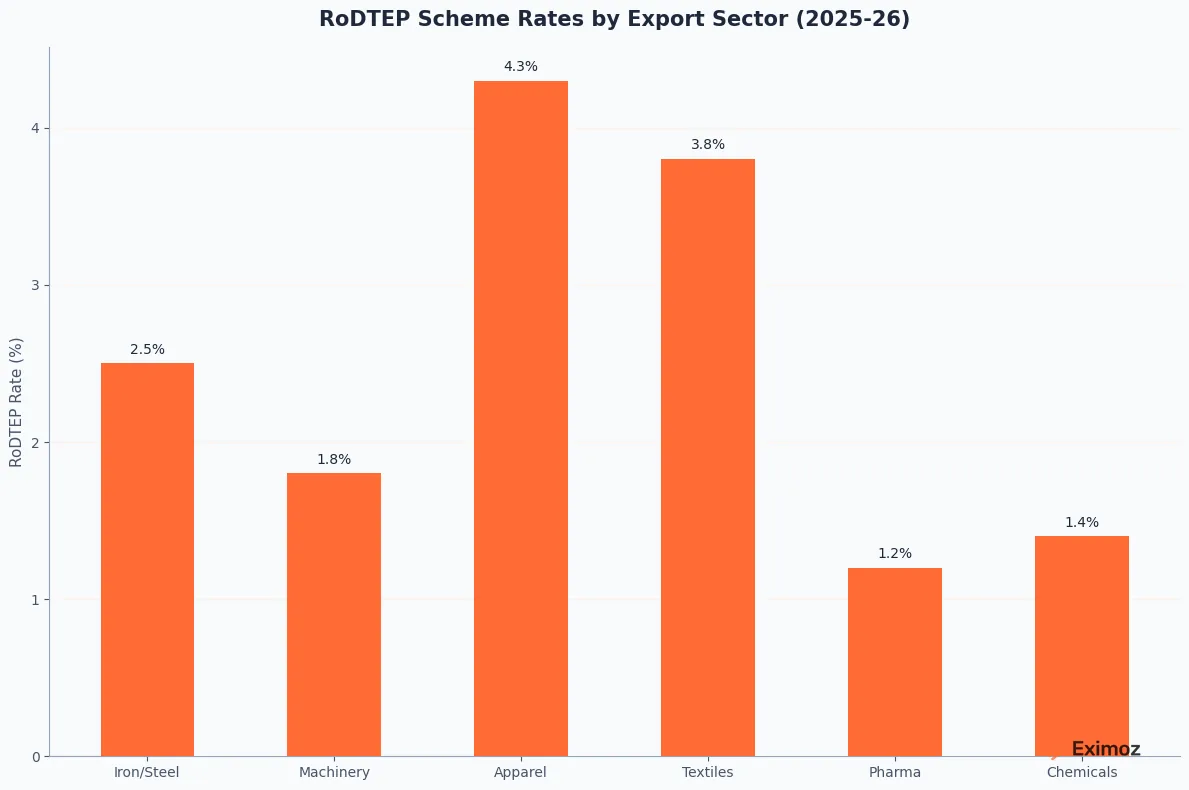
What are the RoDTEP rates for each sector in 2026?
The table below shows typical RoDTEP rates by sector before and after the February 2026 cut. Rates are expressed as a percentage of FOB value. Most tariff lines also carry a per-unit cap in rupees that limits the maximum benefit per piece or per kilogram.

| Sector | HS Chapters | Typical rate (original) | Rate after Feb 2026 cut | Per-unit cap example |
|---|---|---|---|---|
| Marine products | 03, 05 | 1.4%-2.6% | No change (Ch 01-24 exempt) | Rs 3.50/kg |
| Processed food and spices | 07-21 | 0.5%-3.0% | No change (Ch 01-24 exempt) | Rs 2.00-10.00/kg |
| Tobacco products | 24 | 0.5%-1.5% | No change (Ch 01-24 exempt) | Rs 1.50/kg |
| Organic chemicals | 29 | 0.8%-2.0% | 0.4%-1.0% | Rs 1.50/kg |
| Pharmaceutical products | 30 | 0.5%-1.5% | 0.25%-0.75% | Rs 2.00/kg |
| Fertilisers | 31 | 0.5%-0.8% | 0.25%-0.4% | Rs 0.50/kg |
| Dyes and pigments | 32 | 1.0%-2.0% | 0.5%-1.0% | Rs 3.00/kg |
| Plastics and articles | 39 | 0.5%-1.6% | 0.25%-0.8% | Rs 1.00/kg |
| Leather and leather products | 41-42 | 1.0%-2.5% | 0.5%-1.25% | Rs 5.00/piece |
| Cotton and cotton textiles | 52 | 2.5%-4.3% | 1.25%-2.15% | Rs 5.00-17.00/piece |
| Man-made fibre textiles | 54-55 | 1.5%-3.5% | 0.75%-1.75% | Rs 4.00/piece |
| Ready-made garments | 61-62 | 2.5%-4.3% | 1.25%-2.15% | Rs 7.00-17.00/piece |
| Iron and steel products | 72-73 | 0.5%-1.6% | 0.25%-0.8% | Rs 1.00/kg |
| Engineering goods | 73, 76, 82-84 | 0.5%-2.0% | 0.25%-1.0% | Rs 2.00-5.00/piece |
| Electrical machinery | 85 | 0.5%-1.5% | 0.25%-0.75% | Rs 2.00/piece |
| Auto components | 87 | 0.8%-2.0% | 0.4%-1.0% | Rs 3.00/piece |
| Ceramic products | 69 | 1.0%-2.5% | 0.5%-1.25% | Rs 2.00/piece |
| Glass and glassware | 70 | 0.8%-1.5% | 0.4%-0.75% | Rs 1.50/kg |
| Handicrafts and carpets | 57, 97 | 1.5%-3.5% | 0.75%-1.75% | Rs 10.00/piece |
| Gems and jewellery | 71 | 0.5%-1.0% | 0.25%-0.5% | Rs 500/piece |
Source: DGFT Appendix 4R (as notified via Notification No. 32/2024 dated 30.09.2024, read with Notification No. 60/2025-26 dated 23.02.2026). Rates shown are approximate ranges by sector. Your actual rate depends on the exact 8-digit HS code in Appendix 4R.
Two things to note about this table. First, the original rates still apply to HS Chapters 01 to 24 (agriculture, seafood, processed food). The February 2026 cut targeted manufacturing and industrial exports, not farm products. Second, the per-unit cap means high-value products sometimes get less benefit than the percentage would suggest. A garment with FOB value of Rs 500 at 4.3% would be Rs 21.50, but the Rs 17 cap limits the actual credit.
How do I find the exact RoDTEP rate for my HS code?
The official rate for your product is listed at the 8-digit HS code level in DGFT Appendix 4R (for DTA exports) or Appendix 4RE (for SEZ/EOU/AA exports). Here is how to look it up:
- Identify your product's 8-digit ITC-HS code from the Customs Tariff
- Download the latest Appendix 4R from the DGFT RoDTEP page
- Search for your HS code in the schedule. The entry shows the rate as % of FOB and the per-unit cap
- If your export date is after February 23, 2026 and your product falls under HS Chapters 25 onwards, halve both the rate and the cap
The current operative notification is DGFT Notification No. 32/2024 dated 30.09.2024 (as amended by Notification No. 39/2024 for alignment with Customs Tariff changes effective 01.10.2024), further amended by Notification No. 10/2025-26 and No. 11/2025-26 for tariff realignment and SEZ/EOU restoration. The February 2026 rate cut came through Notification No. 60/2025-26.
If your HS code is not listed in Appendix 4R at all, your product is not covered under RoDTEP and no benefit is available.
How are RoDTEP rates calculated and what determines the cap?
RoDTEP rates were fixed by the G.K. Pillai Committee based on the actual incidence of embedded taxes on each product category. The committee examined:
- Central excise duty on fuel (diesel, petrol) used in manufacturing
- State-level electricity duty on power consumed during production
- Mandi tax on procurement of agricultural raw materials
- VAT on fuel used for transporting goods to port
- Stamp duty on export documentation
- Coal cess on coal used in manufacturing
The rate for each HS code reflects the committee's estimate of these embedded costs as a proportion of the product's typical FOB value. Products with higher embedded tax incidence (like textiles, where power and fuel costs are a larger share of FOB) get higher rates. Products with lower incidence (like gems and jewellery, where raw material cost dominates) get lower rates.
The per-unit cap exists to prevent windfall benefits on high-value exports. Without it, an exporter shipping luxury garments at Rs 5,000 FOB per piece would receive Rs 215 per piece at 4.3%, which far exceeds the actual embedded tax incidence. The cap (Rs 17 per piece for that category) keeps the refund proportional to the actual tax burden.
Which exports are excluded from RoDTEP?
Not every export qualifies. The following are excluded from the RoDTEP schedule:
- Products not listed in Appendix 4R or 4RE (no HS code entry = no benefit)
- Products that attract export duty (certain ores, raw hides, some leather categories)
- Re-exported imported goods (no Indian manufacturing involved)
- Exports where the exporter has already claimed full refund of embedded taxes through another mechanism
Until June 2025, exports under Advance Authorization, by SEZ units, and by EOUs were excluded. DGFT Notification No. 11/2025-26 dated May 26, 2025 restored RoDTEP for these categories, with their rates listed in a separate schedule (Appendix 4RE). The rates in 4RE are generally lower than 4R, reflecting the fact that these exporters already get duty-free inputs.
The scheme has been extended until March 31, 2026 via DGFT Notification No. 35/2025. Total government disbursements under RoDTEP crossed Rs 57,976 crore by March 2025, and over 1.11 lakh exporters claimed Rs 15,757 crore in FY 2025-26 (up to December 2025).
Frequently asked questions
What is the RoDTEP rate for textiles and garments?
Textiles and garments get the highest RoDTEP rates, ranging from 2.5% to 4.3% of FOB value. Cotton garments under HS 6109 carry 4.3% with a Rs 17 per-piece cap. Man-made fibre garments typically get 1.5% to 3.5%. After the February 2026 cut, these rates are halved for exports made from that date onward.
What is the RoDTEP rate for chemicals and pharma products?
Organic chemicals (Chapter 29) range from 0.8% to 2.0% of FOB. Pharmaceutical products (Chapter 30) range from 0.5% to 1.5%. After February 2026, these are halved. For example, a pharma product at 1.0% becomes 0.5% for shipping bills filed after February 23, 2026.
Can RoDTEP rates change mid-year?
Yes, and they did exactly that in February 2026. DGFT can revise rates through notifications at any time. The February 2026 cut applied immediately to all exports from the notification date. Exporters should check the DGFT RoDTEP page before calculating benefits on new shipments.
How do I find the RoDTEP rate for my specific product?
Download Appendix 4R from dgft.gov.in/CP/?opt=RoDTEP and search for your 8-digit HS code. The schedule lists the FOB percentage and per-unit cap for each tariff line. If your product falls under HS Chapters 25 onwards and the export date is after February 23, 2026, apply a 50% reduction to the listed rate and cap.
Is there a difference between Appendix 4R and 4RE rates?
Yes. Appendix 4R covers regular DTA (Domestic Tariff Area) exports. Appendix 4RE covers exports by Advance Authorization holders, SEZ units, and EOUs. The 4RE rates are lower because these exporters already import inputs duty-free, so their embedded tax incidence is lower.
Getting the wrong HS code on your shipping bill means the wrong RoDTEP rate, or no benefit at all if the code maps to an unlisted product. Eximoz maps your product to the correct HS code and cross-references the latest RoDTEP schedule automatically, so your team does not have to track notification amendments manually. See how it works at eximoz.com.