

The RCMC (Registration-Cum-Membership Certificate) is an official document issued by Export Promotion Councils (EPCs) or Commodity Boards that registers an exporter with their industry-specific council and is required for claiming government export benefits under India's Foreign Trade Policy. RCMC is obtained online through the DGFT portal at dgft.gov.in, is valid for 5 financial years, and is required for claiming incentives like RoDTEP, Duty Drawback, and EPCG scheme benefits.
What is RCMC and why do Indian exporters need it?
RCMC stands for Registration-Cum-Membership Certificate. It is a certificate issued under the Foreign Trade (Development & Regulation) Act by Export Promotion Councils, Commodity Boards, or Development Authorities authorized by the DGFT (Directorate General of Foreign Trade).
The certificate does two things at once: it registers you as an exporter in your product category, and it gives you membership with the relevant export body. Without RCMC, you can still export goods from India, but you cannot claim any export incentives or benefits that the government offers under the Foreign Trade Policy (FTP).
RCMC is specifically required when:
- You apply to DGFT for any authorisation, benefit, or concession under the FTP
- You want to claim RoDTEP (Remission of Duties and Taxes on Exported Products) benefits
- You want to avail Duty Drawback benefits
- You apply for EPCG (Export Promotion Capital Goods) scheme authorisations
- You want to participate in international trade fairs organized by EPCs
The DGFT has clarified that RCMC must be valid on the date you apply for any benefit or concession. If your RCMC has expired when you submit an application, that application will be rejected.
India has 27 Export Promotion Councils, 6 Commodity Boards, and 2 Development Authorities. Each one covers a specific product sector. For example, EEPC India covers engineering goods, AEPC covers apparel, APEDA covers agricultural and processed food products, and GJEPC covers gems and jewellery. If your product does not fall under any specific council, the Federation of Indian Export Organisations (FIEO) can issue your RCMC.
How to apply for RCMC registration online through the DGFT portal?
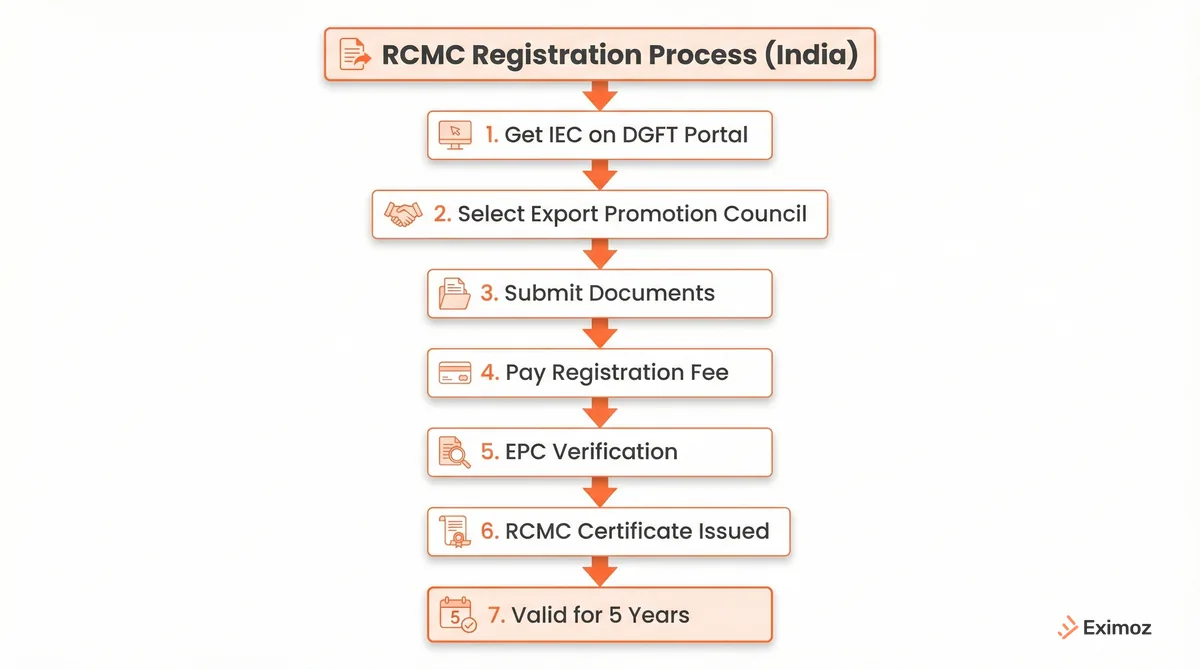
The entire RCMC application process is now digital, done through DGFT's e-RCMC module. Here is the step-by-step process:
Step 1: Get your IEC ready. You need an active Import Export Code (IEC) before applying for RCMC. Your IEC profile on the DGFT portal must be updated with correct details (address, PAN, constitution type).
Step 2: Log in to the DGFT portal. Go to dgft.gov.in and log in using your IEC credentials.
Step 3: Navigate to e-RCMC. Go to Services → e-RCMC → Apply for e-RCMC. Choose "Start Fresh Application."
Step 4: Select your Registering Authority. Pick the Export Promotion Council or Commodity Board that matches your main line of business. If you export engineering goods, select EEPC India. If you export spices, select Spices Board. If your product is not covered by any specific council, select FIEO.
Step 5: Fill the application form. Enter your business details, product/service information, HS codes for your export products, and your main line of business declaration.
Step 6: Upload required documents. Upload scanned copies of all documents the portal asks for (details in the next section).
Step 7: Pay the registration fee. Pay through the integrated payment gateway. The fee varies by council and depends on your export turnover slab.
Step 8: Sign and submit. Sign the application using your Digital Signature Certificate (DSC) or Aadhaar e-Sign.
Step 9: Track and download. After submission, the EPC verifies your documents. Once approved, download your e-RCMC certificate from the DGFT dashboard.
Processing time depends on the specific council, but most applications are approved within 3-7 working days if all documents are correct and the fee is paid.
What documents are required for RCMC registration?
| Document | Purpose | Notes |
|---|---|---|
| Import Export Code (IEC) | Base trade identity | Must be active and profile updated on DGFT portal |
| PAN Card | Business identity proof | Must match the entity applying |
| Aadhaar Card | Identity of applicant/signatory | Required for Aadhaar e-Sign |
| Business Registration Proof | Constitution proof | MOA/AOA for companies, Partnership deed for firms, Proprietorship declaration |
| Bank Certificate or Cancelled Cheque | Bank account verification | Must show printed name matching PAN |
| CA-Certified Export Turnover Statement | Fee slab determination | Last 3 years; NIL certificate for new exporters |
| GST Registration Certificate | Tax compliance proof | Recommended for smooth processing |
| Board Resolution (if company) | Authorization proof | Authorizes the signatory for the application |
| Digital Signature Certificate (DSC) | Application signing | Or Aadhaar e-Sign as an alternative |
New exporters who have not yet completed any exports can still apply for RCMC. They need to submit a NIL export turnover certificate from their CA instead of the turnover statement.
Which Export Promotion Council should you register with for RCMC?
Choosing the right EPC is based on your primary export product. DGFT requires you to declare your "main line of business" during the RCMC application. The council you pick must match this declaration.
Here are the major EPCs and their covered product sectors:
| Export Promotion Council / Board | Product Sector Covered | Website |
|---|---|---|
| EEPC India | Engineering goods, machinery, auto parts, iron & steel | eepcindia.org |
| AEPC | Apparel and textiles | aepcindia.com |
| APEDA | Agricultural and processed food products | apeda.gov.in |
| GJEPC | Gems, jewellery, diamonds | gjepc.org |
| Pharmexcil | Pharmaceuticals and drug formulations | pharmexcil.com |
| CHEMEXCIL | Basic chemicals, cosmetics, dyes | chemexcil.in |
| SEPC | IT, tourism, education, healthcare services | servicesepc.org |
| CLE | Leather and leather products | leatherindia.org |
| EPCH | Handicrafts | epch.in |
| Spices Board | Spices and spice products | indianspices.com |
| Coffee Board | Coffee and coffee products | indiacoffee.org |
| Tea Board | Tea and tea products | teaboard.gov.in |
| Rubber Board | Rubber and rubber products | rubberboard.org.in |
| FIEO | Multi-product / products not covered by any specific council | fieo.org |
What if you export multiple product categories? If your exports span more than one council's jurisdiction, you have two options. You can get RCMC from the council that covers your largest export category. Or, you can get RCMC from FIEO, which acts as a general-purpose council for multi-product exporters.
What if your main line of business changes after getting RCMC? DGFT has clarified that your existing RCMC remains valid until its expiry date even if your main line changes. You do not need to rush into getting a new RCMC immediately.
What are the fees for RCMC registration?
RCMC registration fees are not fixed by DGFT. Each Export Promotion Council sets its own fee structure, usually based on the exporter's annual export turnover. Here is what the fee structure looks like across major councils:
| Council | New Registration Fee (approx.) | Annual Subscription | Turnover-Based Slabs |
|---|---|---|---|
| FIEO | Rs. 5,000 - Rs. 36,000+ | Rs. 5,000 - Rs. 36,000+ | Yes, based on export turnover |
| EEPC India | Rs. 6,500 onwards | Rs. 6,500 - Rs. 60,000+ | Yes, starts at turnover up to Rs. 30 lakh |
| CAPEXIL | Rs. 3,000 - Rs. 5,000 admission | Turnover-based | Rs. 3,000 (under Rs. 25 lakh), Rs. 5,000 (above Rs. 25 lakh) + GST |
| AEPC | Rs. 5,000 onwards | Turnover-based | Yes |
| APEDA | Rs. 5,000 | Rs. 5,000 | Flat fee for most categories |
All fees are subject to 18% GST. Some councils offer discounts for advance payment: FIEO gives 10% discount for 5-year advance payment and 5% for 3-year advance payment.
The fee paid to the council covers both the RCMC issuance and the annual membership subscription. Some councils charge a one-time processing fee on top of the subscription.
What is the validity of RCMC and how does renewal work?
RCMC is valid for 5 financial years. The validity starts from April 1 of the licensing year when it was issued and ends on March 31 of the fifth year.
For example, if your RCMC is issued in August 2025, the validity is deemed to start from April 1, 2025 and expires on March 31, 2030.
Renewal process: You can renew your RCMC through the same DGFT e-RCMC portal. Navigate to Services → e-RCMC → Renewal of RCMC. The portal pre-populates your existing details, and you update whatever has changed. You pay the renewal fee and submit.
When to renew: Start the renewal process at least 1-2 months before expiry. If your RCMC lapses, you cannot claim any export benefits for the period it was inactive.
Amendment process: If your business details change during the validity period (address change, product line updates, change of directors), you can amend your RCMC through Services → e-RCMC → Amendment for RCMC on the DGFT portal.
Important: RCMC validity and council membership subscription are two different things. Your RCMC may be valid for 5 years, but most councils require annual membership subscription payment. If you miss an annual payment, the council may not process your benefit applications even though the RCMC technically has not expired.
What export benefits can you claim with a valid RCMC?
With a valid RCMC, you can claim benefits under these government export promotion schemes:
RoDTEP (Remission of Duties and Taxes on Exported Products): This scheme refunds embedded taxes and duties that are not otherwise refunded through GST. RoDTEP rates vary by product (typically 0.3% to 4.3% of FOB value). RCMC is needed when claiming RoDTEP scrips from DGFT.
Duty Drawback: Refund of customs duties paid on imported inputs used in exported goods. Rates are specified in the Duty Drawback Schedule published by CBIC.
EPCG Scheme: Allows import of capital goods at 0% customs duty for manufacturing export goods. The exporter must fulfil an export obligation of 6 times the duty saved within 6 years.
Advance Authorisation: Duty-free import of raw materials for export production. RCMC is required at the time of application to DGFT.
Market Access Initiative (MAI) Scheme: Financial assistance for participation in trade fairs and buyer-seller meets abroad. EPCs organize these events using MAI funding.
Status Holder Certification: Exporters with consistent export performance can get Star Export House or Trading House status through DGFT, which gives them additional benefits. RCMC and EPC membership records are part of the application.
Frequently Asked Questions
Is RCMC mandatory for all exporters in India?
RCMC is not mandatory for the act of exporting itself. You can export goods with just an IEC. However, RCMC is mandatory if you want to claim any export incentive, concession, or benefit from DGFT under the Foreign Trade Policy. This includes RoDTEP, Duty Drawback through DGFT route, EPCG authorisations, and Advance Authorisation. In practice, most serious exporters get RCMC because the benefits significantly outweigh the registration cost.
How long does it take to get RCMC after applying on DGFT?
The processing time depends on the Export Promotion Council you apply to. Most councils process applications within 3-7 working days if all documents are correctly uploaded and the fee is paid. Delays usually happen because of mismatches between IEC details and uploaded documents, incorrect council selection, or unreadable document scans. FIEO and EEPC India tend to process applications faster due to their larger processing teams.
Can a new exporter with zero export turnover get RCMC?
Yes. New exporters who have not yet exported can apply for RCMC. Instead of the CA-certified export turnover statement, they submit a NIL turnover certificate. Most councils have a base fee slab for new exporters or those with turnover below a certain threshold (for example, EEPC India starts at Rs. 6,500 for turnover up to Rs. 30 lakh, and CAPEXIL charges Rs. 3,000 for turnover below Rs. 25 lakh).
What happens if RCMC expires and I continue exporting?
Your exports will not be stopped at customs if your RCMC expires. Exports happen based on your IEC and Shipping Bill. But you will not be able to file any new applications for export benefits with DGFT. Any pending benefit applications where the RCMC was valid at the time of filing will still be processed. You should renew before expiry to avoid gaps in benefit eligibility.
Can I have RCMC from more than one Export Promotion Council?
DGFT's e-RCMC system allows RCMC from only one council at a time based on your declared main line of business. If you export products across multiple sectors, you register with the council covering your primary export product, or you register with FIEO as a multi-product exporter. You cannot hold simultaneous RCMCs from two different councils.
Getting your RCMC sorted early means you are not leaving government incentives on the table. For exporters managing multiple product lines across different HS codes, keeping track of the right EPC, correct classification, and benefit eligibility gets complicated fast. Eximoz automates HS classification and pre-clearance compliance checks, so your team spends less time on tariff schedules and more time growing exports.