

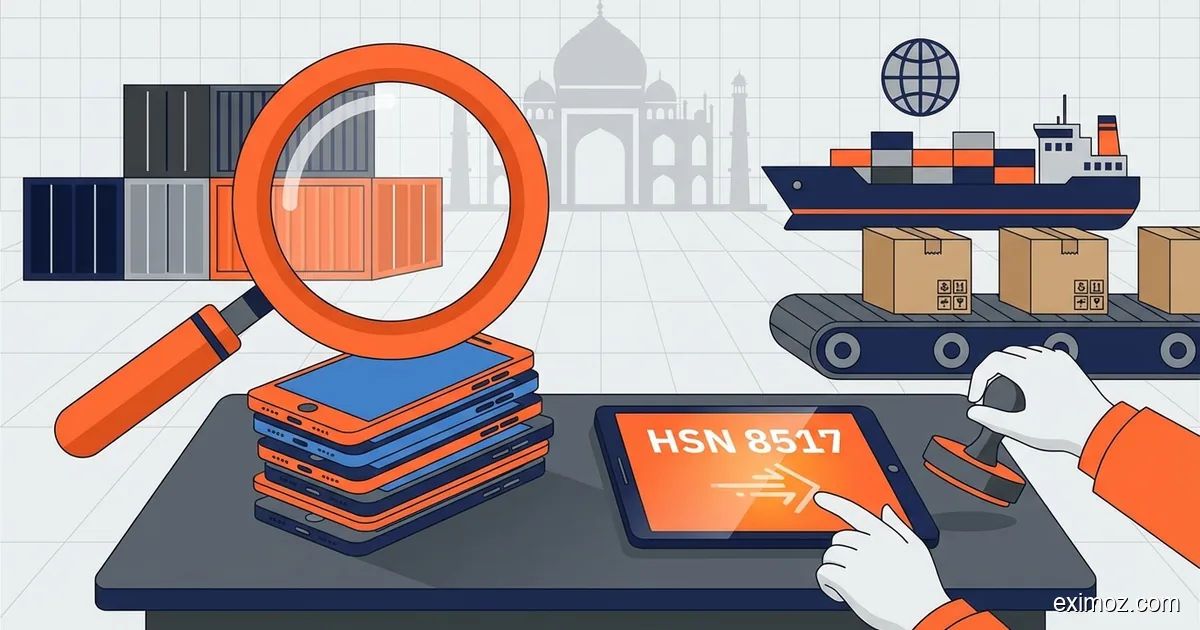
HSN Code for Mobile Phone in India: Smartphones, Accessories & Import Duty Guide The HSN code for mobile phones in India is 8517.13.00 under Chapter 85 of the Customs Tariff Act, 1975, classified as "telephone sets for cellular networks or other wireless networks." Basic Customs Duty (BCD) on mobile phones is 15%, with 18% IGST applicable on the assessable value. BIS registration under IS 16333 (SAR compliance) and TEC (Telecommunications Engineering Centre) approval are mandatory before import.
What is the HSN code for mobile phones in India?
Mobile phones, both smartphones and feature phones, are classified under HSN 8517.13.00 in the Indian Customs Tariff. Chapter 85 covers electrical machinery and equipment, and heading 8517 specifically covers telephone sets and other apparatus for the transmission or reception of voice, images, or other data. The classification history matters here. Before the 2022 tariff revision, smartphones were classified under 8517.12. The shift to 8517.13 aligned India's tariff schedule with the updated WCO Harmonized System nomenclature, which created a separate sub-heading for smartphones (telephone sets for cellular networks incorporating a computing function beyond voice communication). If you're referencing old BoEs or prior-year filings, the heading may show 8517.12. That code is outdated. At the 4-digit level, 8517 covers all telephone sets. At the 8-digit level:
- 8517.13.00: Smartphones (telephone sets for cellular networks with computing capability)
- 8517.14.00: Other telephone sets for cellular networks (feature phones without computing capability beyond voice) In practice, both smartphones and feature phones attract the same BCD rate of 15%. The classification distinction matters for statistical tracking and for schemes like PLI, where the product category definition affects incentive eligibility. 5G phones do not have a separate HSN code. A 5G smartphone is still 8517.13.00. The network technology generation does not change the tariff classification. For GST invoicing on domestic sales, businesses with annual turnover below ₹5 crore can use the 4-digit code (8517). Import documentation (bills of entry, shipping bills, IGST calculations) requires the full 8-digit code.
What is the import duty on mobile phones in India in 2026?
India's import duty on finished mobile phones is among the highest in the electronics category. The government set it that way on purpose, to push manufacturers toward domestic assembly. The duty breakdown on a mobile phone imported at a CIF (Cost, Insurance, Freight) value of ₹10,000: Duty component Rate Amount (on ₹10,000 CIF) Basic Customs Duty (BCD) 15% ₹1,500 Social Welfare Surcharge (SWS) 10% of BCD ₹150 IGST (on assessable value + BCD + SWS) 18% of ₹11,650 ₹2,097 Total duty ₹3,747 Landed cost ₹13,747 The effective total duty is roughly 37.5% above CIF value. This makes importing finished phones expensive compared to importing components and assembling locally. Component duties tell a different story, and that's by design: Component HSN code BCD rate Mobile phone display/touch panel 9013.80 10% Lithium-ion battery 8507.60 15% Printed circuit board (assembled) 8534.00 10% Camera module 8525.80 2.5% SIM socket / connector 8536.90 10% Vibrator motor / ringer 8501.10 7.5% The gap between 15% BCD on a finished phone and 2.5-15% on components is the government's way of saying: assemble here, don't import finished units. Companies like Samsung, Foxconn (for Apple), and Dixon Technologies have set up manufacturing lines in India specifically because this duty differential makes local assembly cheaper than importing.
What licenses are needed to import mobile phones into India?
Importing mobile phones into India requires more regulatory clearances than most electronics categories. Five approvals, roughly in this order: Import Export Code (IEC) from DGFT. This is the basic registration for any import activity. Processing time: 1-2 business days online. BIS Compulsory Registration Scheme (CRS) with two separate registrations:
- IS 16333 (Part 1): Section 2 covers SAR (Specific Absorption Rate) testing for the phone itself. SAR measures the rate of radiofrequency energy absorbed by the body. Every phone model needs its own registration.
- IS 13252 (Part 1) covers the charger/adapter bundled with the phone. If you're selling the phone with a charger, the charger needs separate BIS CRS certification. BIS CRS timeline: 4-8 weeks, depending on testing lab availability. The product must be tested at a BIS-recognized lab before applying. TEC Mandatory Testing and Certification of Telecom Equipment (MTCTE) covers electromagnetic compatibility (EMC) testing and telecom-specific compliance for all wireless communication devices sold in India. Timeline: 6-10 weeks. Apply through the TEC MTCTE portal at tec.gov.in. EPR (Extended Producer Responsibility) registration under the E-Waste Management Rules, 2022. Any company importing electronic products must register for EPR with the Central Pollution Control Board (CPCB). This covers end-of-life collection and recycling obligations. IMEI registration with the Department of Telecommunications. Every mobile phone sold in India must have a valid IMEI number. Phones with duplicate or missing IMEI numbers can be seized at customs. The sequence matters. BIS testing and TEC approval need to happen before you apply for customs clearance. You can start BIS and TEC applications in parallel since they don't depend on each other.
What is the HSN code for mobile phone accessories?
This is where classification gets tricky. Each mobile phone accessory falls under a different HSN chapter, with different duty rates and different regulatory requirements. Classifying everything under 8517 because "it's a phone accessory" is a common mistake, and it triggers assessment queries at customs. Product HSN code BCD rate IGST rate Regulatory requirement Key notes Smartphone 8517.13.00 15% 18% BIS CRS + TEC + EPR SAR testing mandatory Feature phone 8517.14.00 15% 18% BIS CRS + TEC + EPR Same heading as smartphone Mobile phone charger 8504.40.90 15% 18% BIS CRS (IS 13252) Classified as static converter, not under 8517 Earphones/headset (wired) 8518.30.00 15% 18% None Falls under loudspeakers/headphones chapter Bluetooth earphones 8517.62.90 15% 18% TEC approval Wireless = telecom equipment Phone case (plastic) 3926.90.99 10% 18% None Chapter 39 — plastics Phone case (leather) 4202.31.00 10% 18% None Chapter 42 — leather articles Screen protector (plastic film) 3919.90.90 10% 18% None Self-adhesive plastic sheets Screen protector (tempered glass) 7007.19.00 10% 18% None Chapter 70 — safety glass Power bank 8507.60.00 15% 18% BIS CRS Lithium-ion battery classification SIM card tray 7616.99.90 7.5% 18% None Aluminium articles Mobile phone battery 8507.60.00 15% 18% BIS CRS Same heading as power bank The charger classification catches people out most often. A phone charger is a static converter (it converts AC mains power to DC for the phone), which puts it under heading 8504, not 8517. Classifying a charger under 8517 because it ships with the phone will give you the wrong duty calculation and a possible reassessment. Bluetooth earphones are another frequent error. Wired earphones fall under 8518 (loudspeakers and headphones), but Bluetooth earphones are wireless communication apparatus and can fall under 8517.62. The wireless functionality changes the classification chapter.
How does the PLI scheme affect mobile phone import duties?
The Production Linked Incentive (PLI) scheme for Large Scale Electronics Manufacturing, launched by MeitY, is the reason India's mobile phone duty structure looks the way it does. The scheme offers 4-6% incentive on incremental sales (over a base year) to manufacturers who set up or expand mobile phone production in India. Companies like Samsung, Foxconn (manufacturing for Apple), Wistron, Pegatron, Dixon Technologies, Lava, Micromax, and Padget Electronics are approved under PLI. How PLI connects to import duties: The government keeps BCD on finished phones high (15%) while keeping component duties lower (2.5-15%). This creates a duty differential that makes domestic assembly financially attractive. PLI adds a cash incentive on top of that differential. The result: India went from importing most of its smartphones to assembling a large portion domestically. Apple now manufactures iPhone models in India through Foxconn and Tata Electronics (which acquired Wistron's India operations). Samsung's Noida factory is one of the largest mobile phone manufacturing facilities in the world. For importers, the practical takeaway: duties on finished mobile phones are unlikely to decrease. The government wants India to be an electronics manufacturing hub. Expect duties on finished phones to stay at 15% or go higher. Component duties may decrease further as the local supplier ecosystem matures. If you're importing mobile phones or accessories in bulk, knowing which components attract lower duty rates and which finished products attract higher rates is the difference between a viable margin and an unworkable one.
Frequently asked questions
What is the 8-digit HSN code for smartphones in India?
The 8-digit HSN code for smartphones is 8517.13.00 under Chapter 85. This covers telephone sets for cellular networks with computing capability. Feature phones without computing capability fall under 8517.14.00.
What is the customs duty on importing mobile phones to India?
BCD on mobile phones (HSN 8517.13.00) is 15%, revised in Union Budget 2024-25. With Social Welfare Surcharge (10% of BCD) and 18% IGST on the combined assessable value, the total landed cost works out to roughly 38-40% above CIF value.
Is BIS certification required for mobile phones?
Yes — two certifications are mandatory. BIS CRS under IS 16333 covers SAR (Specific Absorption Rate) testing for the phone, and IS 13252 (Part 1) covers the bundled charger. TEC MTCTE approval is also required for all wireless communication devices before customs clearance.
What is the HSN code for mobile phone chargers?
Mobile phone chargers fall under HSN 8504.40.90 (static converters), not 8517 with the phone. A charger converts AC mains power to DC, classifying it as a power supply unit — a common misclassification error that triggers customs reassessment.
Can I import mobile phones for personal use without duty?
Indian residents returning from abroad can bring one mobile phone duty-free under the Baggage Rules, 2016. Commercial imports of any quantity require full customs duty, IEC registration, BIS CRS, TEC approval, and EPR registration.
Importing mobile accessories in bulk means getting the HSN right for each component. Chargers, cases, earphones, and screen protectors all fall under different chapters with different duty rates. Eximoz classifies each product to its correct code automatically, so your BoE is accurate before it reaches the customs officer. Try it at eximoz.com.