


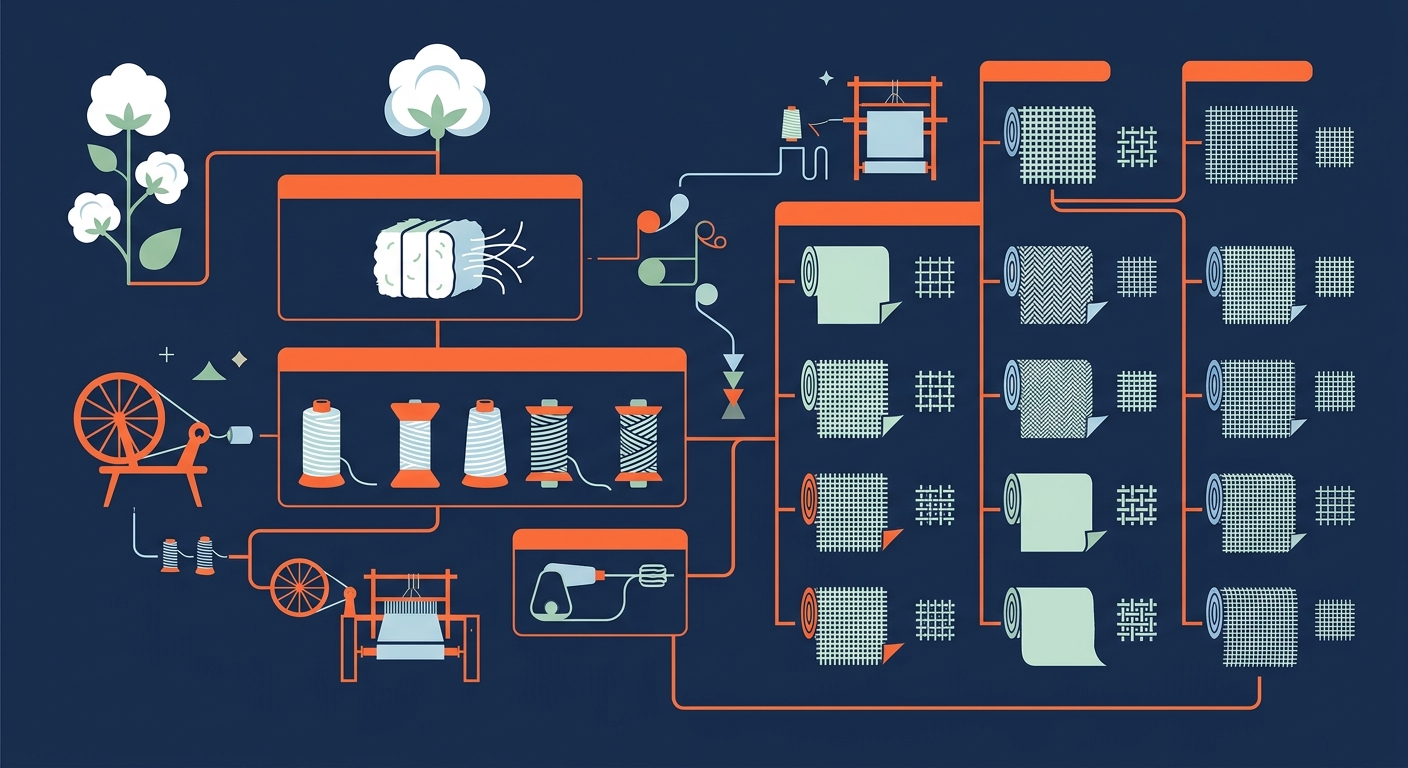
The HSN code for cotton in India spans three chapters: raw cotton falls under Chapter 52 (heading 5201), cotton yarn under headings 5205-5207, and woven cotton fabric under headings 5208-5212. GST on raw cotton is 5%, cotton yarn is 12%, and cotton fabric is 5%. Accurately identifying the correct classification within the Harmonized System of Nomenclature is necessary for determining the applicable customs duties, GST rates, and export incentives for cotton products.
What is the HSN code for raw cotton in India?
Chapter 52 of the Indian Customs Tariff schedule provides the comprehensive framework for cotton, covering the material from its raw states all the way through to woven fabric. Raw cotton, which has not been carded or combed, is classified under heading 5201. The classification system makes a clear distinction between the various forms of raw material. For instance, cotton waste, which includes yarn waste and garnetted stock, falls strictly under heading 5202. Once the raw cotton is processed and either carded or combed, it moves to heading 5203.
At the 8-digit tariff item level, the Indian tariff schedule introduces a distinction based on the origin of the product, separating Indian cotton from other origins. For example, Indian unginned cotton is classified under the specific code 5201 00 11, while unginned cotton of other origins is classified under 5201 00 19. Similarly, ginned Indian cotton falls under 5201 00 21, and ginned cotton of other origins falls under 5201 00 29. Identifying the correct origin and processing state is a requirement for accurate customs declaration.
How is cotton yarn classified under HSN?
The classification of cotton yarn under the HSN system depends on several specific factors, including whether the yarn is single or multiple (cabled), its specific count (measured in Ne), and whether the fibres are combed or uncombed.
Cotton sewing thread has its own distinct category and is classified under heading 5204. Single cotton yarn containing 85% or more cotton by weight, which is not put up for retail sale, falls under heading 5205. If the product is multiple or cabled cotton yarn of the same 85% minimum composition, it is classified under heading 5206. When cotton yarn is packaged and put up for retail sale, the classification changes to heading 5207. Importers and exporters must carefully verify the count and packaging state, as these variables dictate the final 8-digit HSN code.
| Cotton Product | HSN Code | BCD Rate | IGST Rate | GST Rate |
|---|---|---|---|---|
| Raw cotton unginned | 5201 00 11 | 5% | 5% | 5% |
| Ginned cotton | 5201 00 21 | 5% | 5% | 5% |
| Cotton waste | 5202 | 5% | 5% | 5% |
| Carded/combed cotton | 5203 | 5% | 5% | 5% |
| Cotton sewing thread | 5204 | 10% | 12% | 12% |
| Single cotton yarn | 5205 | 10% | 12% | 12% |
| Multiple cotton yarn | 5206 | 10% | 12% | 12% |
| Retail cotton yarn | 5207 | 10% | 12% | 12% |
| Unbleached plain weave fabric | 5208 | 20% | 5% | 5% |
| Bleached cotton fabric | 5209 | 20% | 5% | 5% |
| Dyed cotton fabric | 5210 | 20% | 5% | 5% |
| Printed cotton fabric | 5212 | 20% | 5% | 5% |
What HSN codes apply to woven cotton fabric?
Woven cotton fabric classifications depend entirely on the weight, composition, and specific finishing process applied to the textile.
Heading 5208 covers plain weave cotton fabric weighing 200 grams per square metre or less, provided it contains 85% or more cotton by weight. Heading 5209 covers plain weave fabric that weighs more than 200 grams per square metre.
When dealing with mixed cotton fabric containing less than 85% cotton, mixed mainly or solely with man-made fibres, the classification depends on the weight threshold. If the fabric weighs 200 grams per square metre or less, it is classified under heading 5210. If the exact same mixed fabric composition weighs more than 200 grams per square metre, it shifts to heading 5211.
Other woven cotton fabrics that do not meet the criteria for the previous headings are classified under heading 5212. Across all these fabric headings, there are further 8-digit sub-classifications detailing whether the fabric is in an unbleached, bleached, dyed, or printed state.
What are the GST and customs duty rates on cotton products?
The GST rate structure for the cotton value chain currently exhibits an inverted duty structure. Raw cotton attracts a 5% GST rate at the beginning of the chain. This rate increases to 12% for cotton yarn, before dropping back to a 5% GST rate for woven cotton fabric. If the fabric is further manufactured into ready-made garments (covered under Chapter 61 or 62), the products attract a 5% GST rate for items priced below Rs. 1,000, and a higher 12% GST rate for garments priced above Rs. 1,000.
Basic Customs Duty (BCD) rates vary significantly depending on the processing stage of the imported material. Raw cotton imports (under 5201) generally attract a BCD ranging from 5% to 11%. Processed cotton yarn imports attract a flat 10% BCD. Moving further down the value chain, woven cotton fabric imports attract a 20% BCD, along with the applicable Agriculture Infrastructure and Development Cess (AIDC). All imported cotton products also attract IGST at the applicable domestic GST rate.
For exporters, cotton textile exports are eligible for RoDTEP (Remission of Duties and Taxes on Exported Products) incentives, which provide financial refunds on embedded taxes and duties. Because recent budget changes frequently affect cotton duty rates, verifying the current tariff schedules is required before finalizing any import or export documentation.
What mistakes happen in cotton HSN classification?
Several common errors occur when businesses attempt to classify cotton products for customs clearance.
First, blend percentage errors frequently cause goods to be placed in the wrong chapter. A fabric composed of 60% cotton and 40% polyester is correctly classified as a cotton fabric under Chapter 52 because cotton predominates by weight. However, if the synthetic fibre exceeds 50%, the fabric shifts entirely out of Chapter 52 and into Chapter 54 or 55.
Second, importers often confuse the classifications for ginned and unginned cotton, which carry entirely different 8-digit tariff items.
Third, a major point of confusion is the distinction between knitted and woven fabric. Knitted cotton fabric is classified under Chapter 60. Chapter 52 exclusively covers woven cotton fabric.
Fourth, ready-made garments must be classified under Chapter 61 or Chapter 62. They are entirely distinct from the Chapter 52 fabric codes from which they are made.
Finally, there is a strict distinction between cotton waste (5202) and raw cotton fibre (5201). Misidentifying waste as raw fibre, or vice versa, leads to immediate classification disputes.
Frequently Asked Questions
-
Q: What is the HSN code for raw cotton (unginned and ginned)? A: Raw cotton not carded or combed falls under HSN 5201. Unginned cotton (with seeds) is 5201 00 11 for Indian cotton and 5201 00 19 for other varieties. Ginned cotton is 5201 00 21 (Indian) and 5201 00 29 (other). The GST rate on raw cotton is 5% and BCD is generally 5-10%.
-
Q: What is the HSN code for cotton yarn? A: Cotton yarn HSN codes depend on whether it's single or multiple (folded) yarn, and the count. Single cotton yarn (not for retail) falls under 5205 (combed or uncombed, based on thickness). Multiple or cabled yarn is 5206. Cotton yarn put up for retail sale is 5207. GST on cotton yarn is 12%.
-
Q: What is the GST rate on cotton fabric in India? A: Woven cotton fabric attracts 5% GST. Knitted cotton fabric (Chapter 60) also attracts 5% GST. However, if cotton fabric is further processed into ready-made garments (Chapter 61/62), the GST rate changes to 12% for garments priced above Rs. 1,000.
-
Q: How do I classify cotton blends for customs? A: Cotton blended with other fibres is classified based on the fibre that predominates by weight. A fabric with 60% cotton and 40% polyester is classified as cotton fabric under Chapter 52. If synthetic fibre exceeds 50%, it falls under Chapter 54 or 55. The exact HSN sub-heading depends on weave type and weight per square metre.
-
Q: What is the customs duty on cotton imports into India? A: BCD on raw cotton (5201) ranges from 5-11%. Cotton yarn imports attract 10% BCD, and cotton fabric imports attract 20% BCD + applicable AIDC. India also applies safeguard duty or anti-dumping duty on certain cotton products from specific countries. All cotton imports attract IGST at the applicable GST rate.
India is the world's largest cotton producer - if you're exporting cotton yarn or fabric, Eximoz auto-classifies your Chapter 52 shipments and calculates the correct GST and export incentive (RoDTEP) rates instantly.