

BIS certification is a mandatory product quality certification issued by the Bureau of Indian Standards that importers must obtain before bringing certain categories of goods into India. Under the Compulsory Registration Scheme (CRS) for electronics and the ISI Mark scheme for other products, importers must register each product model with BIS after testing at a recognized laboratory. The process typically takes 6–12 weeks for CRS and 3–6 months for ISI Mark.
What is BIS certification and why do importers need it?
The Bureau of Indian Standards (BIS) is India's national standards body, established under the BIS Act 2016. It sets product quality and safety standards, called Indian Standards (IS), for everything from electronics to steel to toys.
For importers, BIS certification matters because of Quality Control Orders (QCOs). When the Government of India issues a QCO for a product category, every unit of that product sold or imported into India must conform to the relevant IS standard. No BIS registration means customs will not grant Out of Charge. Your goods sit at the port, accumulating demurrage.
The scope of mandatory BIS certification has been expanding steadily. The government added toys in 2021, tightened requirements for helmets and pressure cookers, and continues issuing new QCOs each year. If you import into India regularly, products that didn't need BIS last year may need it this year.
Which products require BIS certification for import into India?
The list of products under mandatory BIS certification runs into hundreds of items across multiple QCOs. The major categories importers deal with most:
- Electronics and IT products (under CRS): Laptops (see our HSN code guide for laptops), desktop computers and servers, mobile phones (see our HSN code guide for mobile phones), tablets, power banks, chargers and adapters, LED lamps, microwave ovens, printers, and set-top boxes. The CRS scheme currently covers 81 product categories.
- Steel and steel products: TMT bars, structural steel, stainless steel, galvanized sheets, covered under multiple QCOs issued by the Ministry of Steel.
- Chemicals and petrochemicals: Industrial chemicals, solvents, and related products under QCOs from the Department of Chemicals and Petrochemicals.
- Toys: All toys sold in India require ISI Mark certification since January 2021, covering mechanical, chemical, electrical, and flammability safety standards.
- Household goods: Pressure cookers, gas stoves, domestic electric appliances, and water heaters.
- Other categories: Cement, automotive parts, solar photovoltaic modules, safety glass, and helmets.
The full list of products under compulsory certification is maintained on the BIS website. Check it before every new import — the list gets updated more often than most importers expect.
How does the BIS Compulsory Registration Scheme (CRS) work?
CRS is the scheme most electronics and IT importers will deal with. It works differently from the ISI Mark scheme in a few important ways.
CRS is self-declaration based. The manufacturer declares that the product meets the applicable IS standard, backed by a test report from a BIS-recognized laboratory. There is no mandatory factory audit (though BIS reserves the right to inspect).
Each registration covers one manufacturer, one product model, and one IS standard. If you import three models of the same product from the same manufacturer, you need three separate CRS registrations.
The registration number must appear on every unit imported. Customs checks for this. If the BIS registration number is missing from the product label, the shipment will be held even if you hold a valid registration.
| Feature | CRS (Electronics) | ISI Mark (Industrial) | FMCS (Foreign Manufacturer) |
|---|---|---|---|
| Applicable products | Electronics, IT (81 categories) | Steel, cement, chemicals, toys, appliances | Same as ISI Mark, for factories outside India |
| Relevant standard examples | IS 13252 (IT equipment), IS 16102 (LED lamps) | IS 1239 (steel tubes), IS 9873 (toys) | Same IS standards as ISI Mark |
| Application fee | Rs. 1,000 per model | Rs. 1,000 | Rs. 1,000 (in INR equivalent) |
| Processing fee | Rs. 25,000 | Included in licence fee | Included in licence fee |
| Testing required | Yes, at BIS-recognized lab | Yes, at BIS-recognized lab | Yes, at BIS-recognized lab |
| Validity period | 2 years | 1–2 years (varies by licence) | 1–2 years |
| Renewal process | Apply before expiry | Apply before expiry | Apply before expiry |
| Factory inspection | Not mandatory (BIS may inspect) | Mandatory before grant | Mandatory — BIS inspects foreign factory |
| Time to obtain | 6–12 weeks | 3–6 months | 4–8 months |
| Authorized Indian Representative needed | Yes (for foreign manufacturers) | No (applicant is the manufacturer) | Yes — mandatory AIR appointment |
What is the step-by-step BIS registration process for importers?
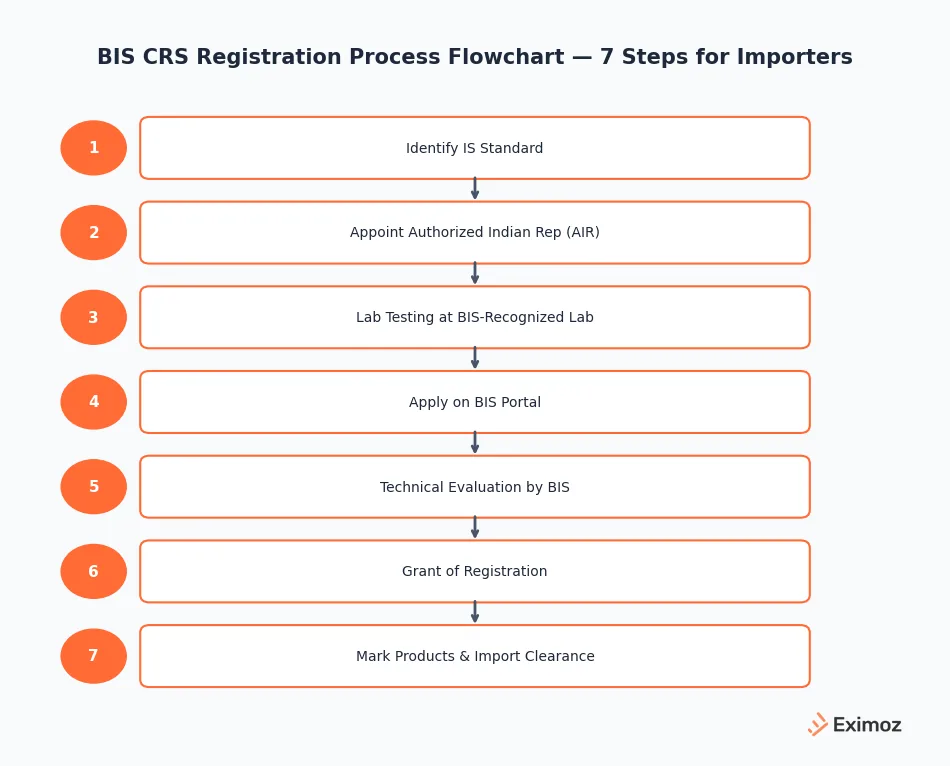 Figure 1: Step-by-step BIS CRS registration process for manufacturers and importers in India
Here is the CRS registration process, which is what most importers follow for electronics and IT products:
Step 1: Identify the applicable IS standard. Check the BIS CRS portal at crsbis.in to find which Indian Standard applies to your product. Getting this wrong means starting over, so verify the standard number before anything else.
Step 2: Appoint an Authorized Indian Representative (AIR). If the manufacturer is based outside India (most commonly China, Taiwan, or Korea), they must appoint an AIR. The AIR is a legal entity registered in India that acts as BIS's point of contact and is legally responsible for compliance. This is where many first-time importers from China get stuck — the AIR must be in place before you can even apply.
Step 3: Get the product tested at a BIS-recognized laboratory. The product must be tested against the applicable IS standard at a NABL-accredited, BIS-recognized lab. Testing takes 2–4 weeks depending on the product and lab backlog. Costs range from Rs. 20,000 to Rs. 80,000 per model depending on the IS standard.
Step 4: Submit the application on the BIS portal. File the application on the CRS portal with the test report, product details, manufacturer information, and AIR details (if applicable). The application fee is Rs. 1,000 plus a Rs. 25,000 processing fee per model.
Step 5: BIS reviews the application. BIS conducts a technical evaluation of the test report and application. Common rejection reasons: incomplete documentation, test report not matching the product model specified, or testing done at a non-recognized lab. If BIS raises queries, respond within the specified timeline or the application lapses.
Step 6: Registration is granted. Once approved, BIS issues the registration certificate with a unique R-number. This registration is valid for 2 years.
Step 7: Mark products with the BIS registration number. Every unit imported must carry the BIS registration number on the product and packaging. Customs specifically checks for this marking during clearance.
Total cost per model: Rs. 46,000–1,06,000 including application fee, processing fee, and lab testing. Timeline: 6–12 weeks from application to approval, assuming no queries or rejections.
What happens if you import without BIS certification?
Importing without BIS certification is not a documentation gap you can fix at the port.
Customs will refuse Out of Charge (OOC). Your goods stay in the CFS or port warehouse while demurrage charges escalate weekly. Your only options: re-export at your own cost, or destruction at your own cost. Both are expensive, and both mean your goods never reach the market.
Under the BIS Act 2016 Section 29, penalties for contravention of compulsory certification requirements start at Rs. 2 lakh and can go up to 10 times the value of the goods. Under Section 29(3), even a first contravention can carry imprisonment of up to 2 years, or fine, or both.
This happens regularly. Shipments of electronics, toys, and steel get held at Indian ports every week for missing BIS registrations. The most common scenario: an importer's CRS registration expires (valid only 2 years), they forget to renew, and the next shipment gets stuck.
Frequently asked questions
What is BIS certification for imports in India?
BIS certification is a product quality and safety certification issued by the Bureau of Indian Standards. For importers, it works through two main schemes: the Compulsory Registration Scheme (CRS) for electronics and IT products, and the ISI Mark scheme for products like steel, cement, and chemicals. Without valid BIS registration, customs will not release the goods from the port.
How long does BIS certification take?
The CRS registration process takes 6–12 weeks from application to approval. This breaks down to product testing at a BIS-recognized lab (2–4 weeks), application submission and BIS processing (2–4 weeks), and grant of registration (1–2 weeks). The ISI Mark licence process runs longer, usually 3–6 months.
What is the cost of BIS certification for importers?
For CRS, the application fee is Rs. 1,000 per model, plus Rs. 25,000 processing fee, plus testing charges that vary by product (typically Rs. 20,000–80,000 per model depending on the IS standard). Total upfront cost per model comes to Rs. 46,000–1,06,000 including testing. Registration is valid for 2 years, and renewal costs are similar.
Can a foreign manufacturer apply for BIS directly?
Foreign manufacturers can apply for BIS CRS registration, but they must appoint an Authorized Indian Representative (AIR) based in India. The AIR is legally responsible for compliance, and the manufacturer must allow BIS to conduct factory inspections if required. Finding a reliable AIR is often the first real hurdle for foreign manufacturers entering India.
What products are exempt from BIS certification for import?
Products imported for R&D, testing, personal use (within specified limits), display at exhibitions, or re-export are generally exempt. Products under specific government schemes or diplomatic imports may also be exempt. However, bulk commercial imports always require BIS compliance if the product falls under any mandatory BIS standard.
Keep your BIS compliance on track
BIS certification adds a layer of planning to every import: identifying the right standard, testing, registration, renewal tracking. Miss any step and your shipment doesn't clear.
Eximoz flags BIS requirements automatically based on your HSN code, so you know what registrations you need before the goods ship, not after they're stuck at port. Check your product's BIS requirements at eximoz.com.