

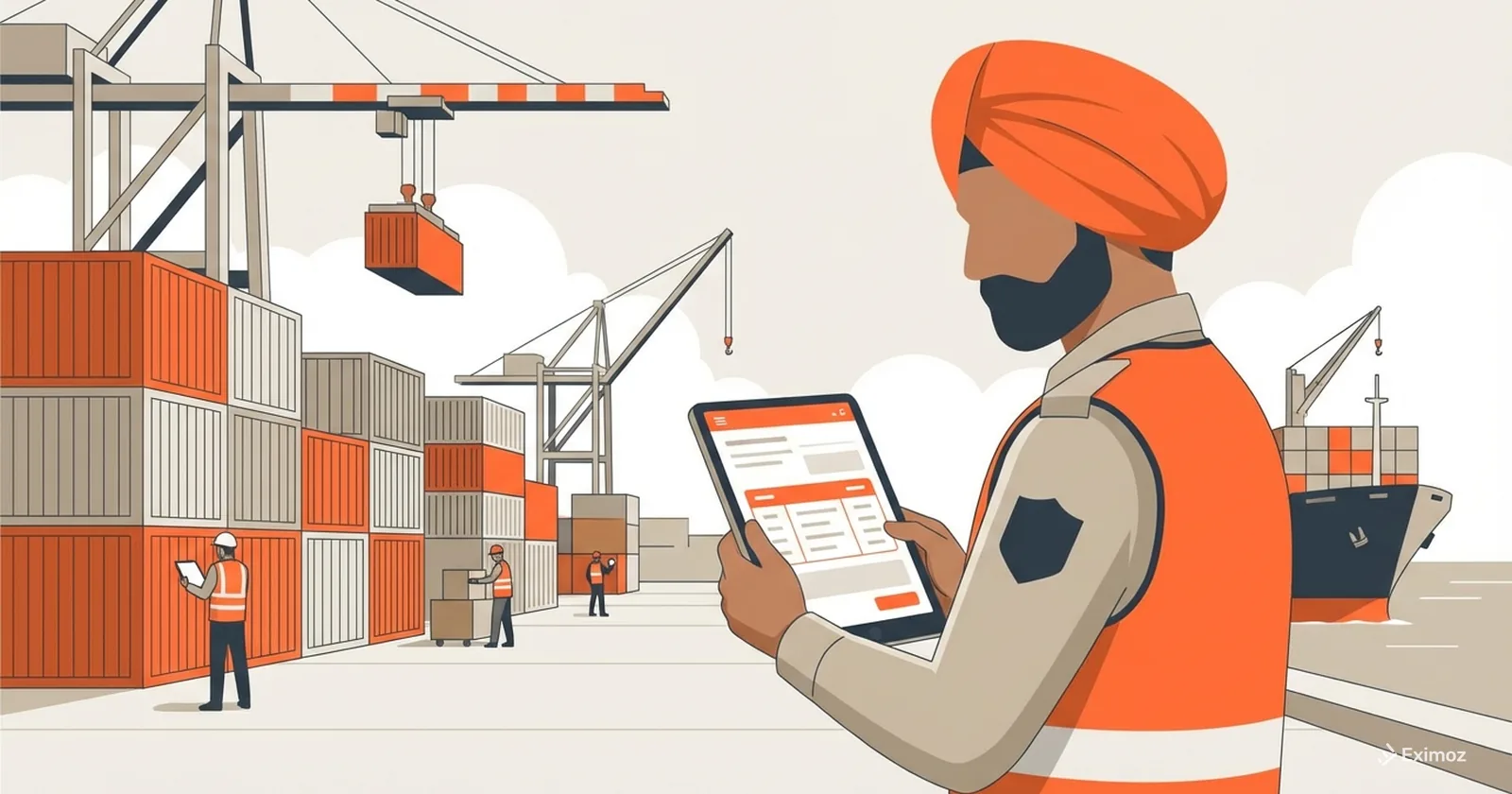
Bill of Entry in India: Complete Guide to Format, Types & Filing Process
A Bill of Entry (BoE) is a legal document filed with Indian Customs under Section 46 of the Customs Act, 1962, declaring the details of imported goods for assessment of customs duty. It is filed electronically through ICEGATE (Indian Customs EDI Gateway) and is mandatory for clearing any imported goods from Indian ports and airports.
What is a Bill of Entry in India?
A Bill of Entry is the declaration an importer or their Customs House Agent (CHA) submits to Indian Customs before imported goods can be cleared. Section 46 of the Customs Act, 1962 makes this filing mandatory for all imports, whether by sea, air, or land.
The primary purpose is duty assessment: Customs uses the declared value, quantity, and classification to calculate what you owe. It also creates a statistical record for the government to track import volumes, and it triggers regulatory checks on licenses and certificates for restricted goods.
India moved from paper-based BoE filing to the Electronic Data Interchange (EDI) system in the late 1990s. Today, almost all customs stations operate on the Indian Customs EDI System (ICES), and BoEs are filed through the ICEGATE portal at icegate.gov.in. Manual filing is only permitted at non-EDI stations, which are increasingly rare.
Since 2011, India follows a self-assessment system. The importer declares the HS classification, value, and applicable duty rates. Customs officers verify and may reassess if they disagree, but the initial responsibility sits with the importer. This makes accurate classification and valuation your problem, not Customs' problem.
What are the different types of Bill of Entry?
There are three types of Bill of Entry in India, each used for a different import scenario.
Bill of Entry for Home Consumption (White BoE) is the most common type. You file this when goods are being cleared directly into the domestic market with full payment of all applicable customs duties (BCD, IGST, Compensation Cess, and any anti-dumping or safeguard duties). Once cleared, goods move straight to your warehouse or factory.
Bill of Entry for Warehousing, also called Into-Bond BoE (Yellow BoE), is filed under Section 59 of the Customs Act when you want to store imported goods in a customs bonded warehouse without paying duty immediately. This is useful when you need the goods but want to defer duty payment, or when you plan to re-export them. Duty becomes payable only when goods are removed from the warehouse for domestic use.
Ex-Bond Bill of Entry (Green BoE) is filed when you clear goods that were previously warehoused under an Into-Bond BoE. The duty is calculated at the rate applicable on the date of removal from the warehouse, not the date of original import. This is an important distinction because tariff rates can change between the time goods entered the warehouse and the time you clear them.
Three types of Bill of Entry compared
| Feature | Home Consumption (White) | Warehousing / Into-Bond (Yellow) | Ex-Bond (Green) |
|---|---|---|---|
| Purpose | Direct clearance into domestic market | Storage in bonded warehouse, duty deferred | Clearing previously warehoused goods |
| When duty is paid | At the time of import clearance | When goods are removed from warehouse | At the time of removal from warehouse |
| Section of Customs Act | Section 46 | Section 59 | Section 68 |
| When to use | Standard imports for immediate use or sale | When you want to defer duty or may re-export | When removing warehoused goods for domestic consumption |
| Colour code | White | Yellow | Green |
| Common scenarios | Regular raw material imports, finished goods for resale | Bulk commodity imports, goods awaiting buyer confirmation | Partial clearance from bonded warehouse stock |
| Key documents needed | Standard BoE documents + duty payment challan | Standard BoE documents + warehouse license details | Ex-Bond BoE + original Into-Bond BoE reference + duty payment |
Source: CBIC Customs Manual 2023, Chapter 10 (cbic.gov.in/htdocs-cbec/customs/cs-manual)
How to decide which one to file: If you are clearing goods for immediate use or sale, file a Home Consumption BoE. If you are not ready to pay duty or might re-export the goods, file an Into-Bond BoE. If you previously warehoused goods and now want to clear them, file an Ex-Bond BoE.
What information is included in a Bill of Entry format?
A BoE captures every detail Customs needs to assess duty and verify compliance. Here is what each section covers:
Importer details: Your IEC (Import Export Code) number, GSTIN, name, address, and AD (Authorized Dealer) code for foreign exchange purposes. If a CHA is filing on your behalf, their license number goes here too.
Goods description: A precise description of the imported goods, the 8-digit HSN/HS code (not 4-digit, which is insufficient for customs), quantity, unit of measurement, and the CIF (Cost, Insurance, Freight) value. The description must match the commercial invoice exactly. Vague descriptions like "electronic parts" or "machinery components" invite queries and delays.
Duty calculation: BCD (Basic Customs Duty) rate, Social Welfare Surcharge (SWS) at 10% on BCD, IGST rate and amount, Compensation Cess if applicable, and any anti-dumping duty or safeguard duty. The system calculates total duty based on what you declare, so wrong classification or valuation means wrong duty.
Shipping details: Bill of Lading or Airway Bill number, vessel or flight name, port of loading, port of discharge, country of origin, and country of consignment. The country of origin matters for FTA (Free Trade Agreement) preferential duty rates.
License and authorization numbers: If the import requires a specific license (BIS registration for electronics, FSSAI license for food products, Drug Import License for pharmaceuticals, DGFT authorization for restricted items), those details are entered here. Missing a required license is one of the most common reasons goods get held at port.
Common field-level errors to avoid: entering a 4-digit HS code instead of the full 8-digit code, declaring FOB value instead of CIF, leaving the country of origin blank when claiming FTA benefits, and not updating the AD code when switching banks.
How do you file a Bill of Entry on ICEGATE?
The filing process follows seven steps:
Step 1: Register on ICEGATE. You need an IEC, a Class 3 Digital Signature Certificate (DSC), and a registered ICEGATE account. Registration is free. Your CHA can file on your behalf using their own ICEGATE credentials.
Step 2: Prepare supporting documents. Gather the Commercial Invoice, Packing List, Bill of Lading or Airway Bill, Country of Origin Certificate, Insurance Certificate, Purchase Order, and any product-specific licenses (BIS, FSSAI, CDSCO, etc.). All documents should be consistent with each other on quantities, values, and descriptions.
Step 3: Enter BoE data in ICES. Log in to ICEGATE and enter the BoE details: importer information, goods description with 8-digit HS code, quantity, value, and applicable duty rates. The ICES (Indian Customs EDI System) is the backend system that processes the data.
Step 4: System validates and assigns a BoE number. ICES runs automated checks on your data (IEC validity, HS code format, duty rate consistency). If validation passes, the system assigns a BoE number and date. If it fails, you get error messages to correct and resubmit.
Step 5: Duty assessment. Under self-assessment, the duty you declared is provisionally accepted. The assessing officer may accept your self-assessment or reassess if the classification, value, or duty rate appears incorrect. Reassessment triggers a speaking order explaining the officer's reasoning.
Step 6: Pay duty via e-payment. Duty is paid electronically through NEFT, RTGS, or designated authorized banks. ICEGATE generates a challan for payment. Duty must be paid before goods can be examined or released.
Step 7: Examination and Out of Charge (OOC). After duty payment, goods may be selected for physical examination (based on risk management system profiling) or given a direct OOC. Once the examining officer is satisfied, an Out of Charge order is issued, and you can move the goods out of the port.
Typical timeline: If your documents are in order and goods are not selected for examination, clearance takes 2-3 working days from BoE filing. For goods requiring physical examination or testing (chemicals, pharmaceuticals), add 2-5 days.
What is the time limit for filing a Bill of Entry?
Section 46(3) of the Customs Act specifies different deadlines depending on how goods arrive:
Sea cargo: The BoE must be filed by the end of the next day (excluding holidays) after the vessel arrives at the port. For example, if the ship docks on Monday, your BoE is due by Tuesday end of day.
Air cargo: The BoE must be filed before the goods arrive at the air cargo complex.
Advance filing: You can file a BoE up to 30 days before the expected arrival of the vessel or aircraft. The Sea Cargo Manifest and Transhipment Regulations, 2018 have made advance filing effectively mandatory at major ports like JNPT, Chennai, and Mundra. Filing in advance means your goods can be assessed and cleared faster, sometimes on the same day as arrival.
Late filing penalties: If you miss the deadline, Section 46(3) imposes a late fee of Rs. 5,000 per day for the first three days and Rs. 10,000 per day after that. On a large consignment sitting at port, demurrage and container detention charges stack on top of this penalty. A week's delay can easily cost Rs. 1-2 lakh between late fees, port charges, and container rental.
Why advance filing matters: Beyond avoiding penalties, advance filing allows Customs to complete assessment before the goods physically arrive. At ports with the Direct Port Delivery (DPD) facility, goods filed in advance can move directly from the vessel to your truck without entering the CFS (Container Freight Station). This cuts 2-3 days and Rs. 15,000-25,000 in CFS handling charges per container.
What mistakes do importers commonly make with Bill of Entry?
These are the errors that cause the most delays, reassessments, and penalties:
Wrong HSN classification. Filing under an incorrect HS code is the single biggest source of customs disputes. A 4-digit mismatch can change your BCD rate from 5% to 15%, trigger anti-dumping duties you did not anticipate, or require licenses you do not have. Reassessment means the goods sit at port while the dispute is resolved.
Incorrect valuation. Declaring a value lower than what Customs considers reasonable triggers a Special Valuation Branch (SVB) inquiry for related-party transactions, or a simple loading of value for arm's length transactions. Undervaluation is taken seriously; it can lead to confiscation proceedings under Section 111 of the Customs Act.
Missing product-specific licenses. BIS registration for electronics, FSSAI license for food items, CDSCO Drug Import License for pharmaceuticals, and Wildlife CITES permits for certain products are all checked at the BoE stage. If you do not have the license, your goods are held. Getting the license after filing does not always help because the BoE may need to be amended or refiled.
Not claiming FTA benefits when eligible. If your goods originate from a country with which India has a Free Trade Agreement (ASEAN, Japan, South Korea, etc.), you can claim a reduced or zero BCD rate. But you must have the Certificate of Origin, declare the FTA benefit in the BoE, and ensure the HS code matches the FTA's product coverage. Many importers pay full duty simply because they did not claim the benefit at filing.
Filing after arrival instead of in advance. Late filing attracts penalties and delays clearance by pushing your goods into the standard assessment queue instead of the advance assessment queue.
Frequently Asked Questions
What is a Bill of Entry and why is it required for imports?
A Bill of Entry is a statutory document filed under Section 46 of the Customs Act, 1962 that declares the description, quantity, value, and classification of imported goods. Customs authorities use it to assess and collect the correct import duties. Without filing a BoE, goods cannot be cleared from the port or airport.
How many types of Bill of Entry are there in India?
There are three types. Bill of Entry for Home Consumption (white) is for goods cleared directly into the domestic market with full duty payment. Bill of Entry for Warehousing (yellow/into-bond) is for goods stored in a customs bonded warehouse with duty deferred. Ex-Bond Bill of Entry (green) is for clearing goods previously warehoused, with duty paid at the time of removal.
Can I file a Bill of Entry before the ship arrives?
Yes. Under the Advance Bill of Entry provision, you can file a BoE up to 30 days before the expected arrival of the vessel or aircraft. The Sea Cargo Manifest and Transhipment Regulations, 2018 have made advance filing effectively mandatory at major ports. Filing in advance speeds up clearance significantly and can qualify you for Direct Port Delivery.
What is the penalty for late filing of a Bill of Entry?
If the BoE is not filed within the stipulated time (by end of the next day after arrival at a sea port, or before arrival at an air cargo complex), a late fee of Rs. 5,000 per day is charged for the first three days, and Rs. 10,000 per day after that, as per Section 46(3) of the Customs Act. Demurrage and container detention charges apply on top.
What documents are needed to file a Bill of Entry?
The required documents include: Commercial Invoice, Packing List, Bill of Lading or Airway Bill, Country of Origin Certificate, Purchase Order or Contract, Insurance Certificate, IEC (Import Export Code), GSTIN, and any product-specific licenses such as BIS registration, FSSAI license, or Drug Import License. If claiming preferential duty rates under a Free Trade Agreement, you also need the FTA Certificate of Origin.
Getting HS classification and duty calculations right on the BoE is where most errors start. Eximoz automates HS code classification and pre-validates your BoE data against customs tariff schedules, flagging mismatches before you file. If your team processes high volumes of imports, it is worth a look at eximoz.com.